A rights issue is when a listed company offers existing shareholders the opportunity to purchase additional new shares in proportion to their current holdings. If shareholders choose not to participate, their shareholding will be diluted.
Example:
If a company announces a two-for-one rights issue, it means that for every two shares you already hold, you have the right to buy one new share.
1.What is a rights issue?
1.1 What are rights and how do rights issues work?
Rights give you the option to purchase new shares of the company (the underlying shares) at a set price. Rights are usually issued with their own stock symbol and can be traded on the market if allowed by the company.
The naming format is typically: Stock Name + "Rights".
When you exercise your rights, you can buy new shares at the rights issue price, according to the number of rights you hold.
Example:
If you hold 5,000 Tencent rights and the rights issue price is HK$100, you can apply to buy 5,000 Tencent shares (stock symbol: 00700) for a total of HK$500,000.
1.2 How are rights distributed?
The company issues rights to all eligible shareholders. If you hold your shares in a securities account, rights will be credited directly by the exchange. If you hold physical share certificates, you may need to complete procedures at the share registrar.
After the rights are distributed, the share price of the original stock typically decreases by approximately the value of the rights.
1.3 How are rights traded?
Rights can be either tradable or non-tradable, depending on the issuing company's decision.
- Tradable rights: These rights can be bought and sold on the market, similar to ordinary shares, with prices fluctuating according to market conditions. Investors who acquire tradable rights may apply to subscribe for new shares under the rights issue.
- Non-tradable rights: Investors can only choose whether to subscribe for new shares. If they choose not to subscribe, the rights will expire and become worthless.
1.4 What is the lifecycle of rights?
The lifecycle of rights typically includes the following key dates: the listing date, the last trading date, the subscription deadline, and the allotment date of new shares.
Tradable rights are usually available for about five to seven trading days and can be freely bought or sold between the listing date and the last trading date.
Investors may exercise their rights to subscribe for new shares at any time from the listing date up to the subscription deadline.
The new shares subscribed for through the rights issue will be credited to investors' accounts on the allotment date.
1.5 What are the key features of rights?
- Name: The name of the underlying stock followed by "Rights"
- Symbol: Typically begins with "29" (for tradable rights) or "44" (for non-tradable rights)
- Underlying Stock Name: The corresponding underlying share
- Underlying Stock Symbol: The symbol of the corresponding underlying share
- Lot Size: Number of shares per trading lot
- Subscription Price: Price at which new shares can be subscribed during the rights offering
- Tradable: Yes/No (Tradable symbols start with "29", non-tradable symbols start with "44")
1.6 How are rights handled?
- Tradable rights: Rights may be sold in the market, exercised to subscribe for new shares, or allowed to expire.
- Non-tradable rights: Rights may be exercised to subscribe for new shares, or allowed to expire.
If rights are not exercised or sold before the expiration date, they will become void and lose all value. The asset represented by the rights will be forfeited.
2. How to participate in a rights issue
2.1 Receiving rights issue information
Before the subscription period starts, all eligible shareholders will be notified via in-app notification and email.
2.2 How to subscribe for new shares
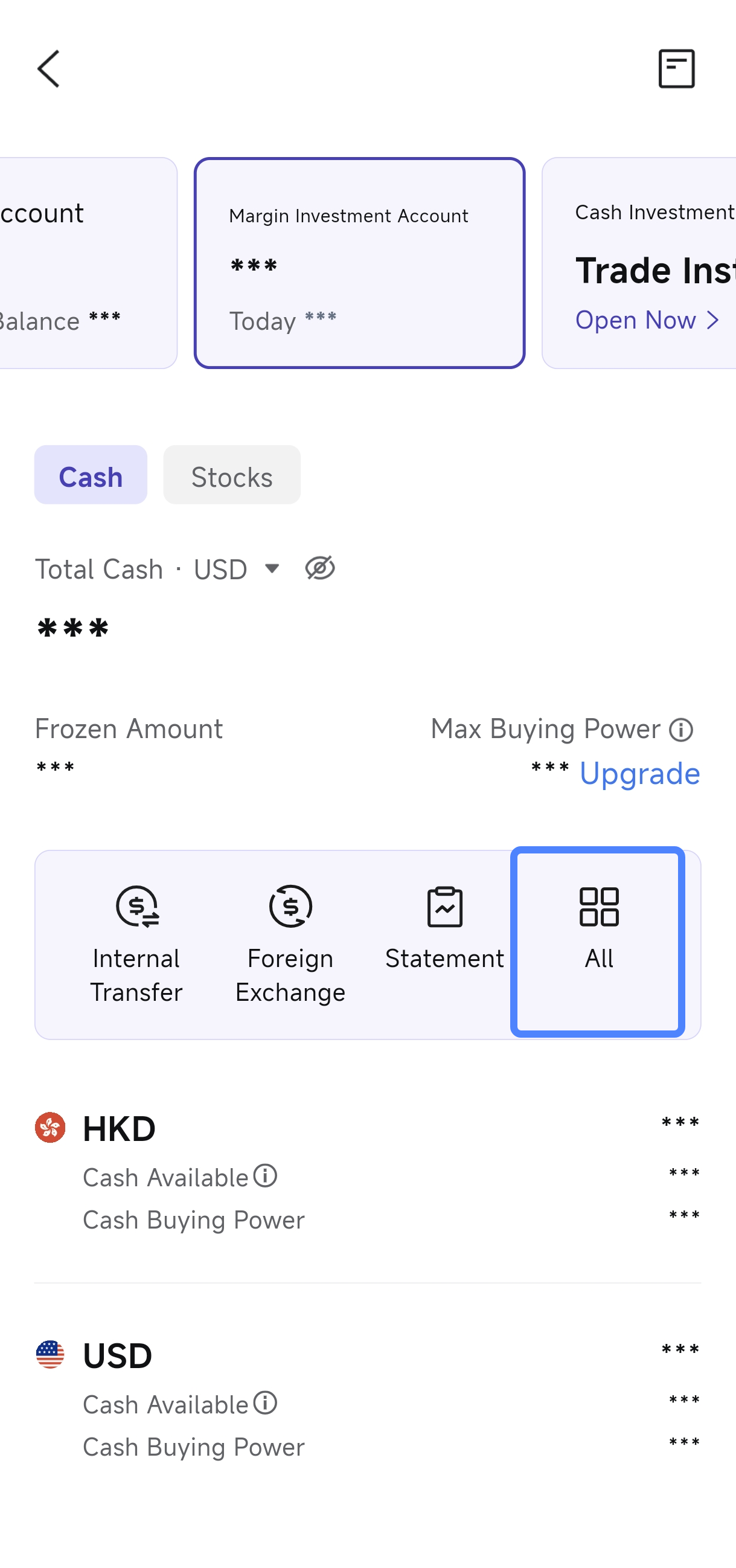
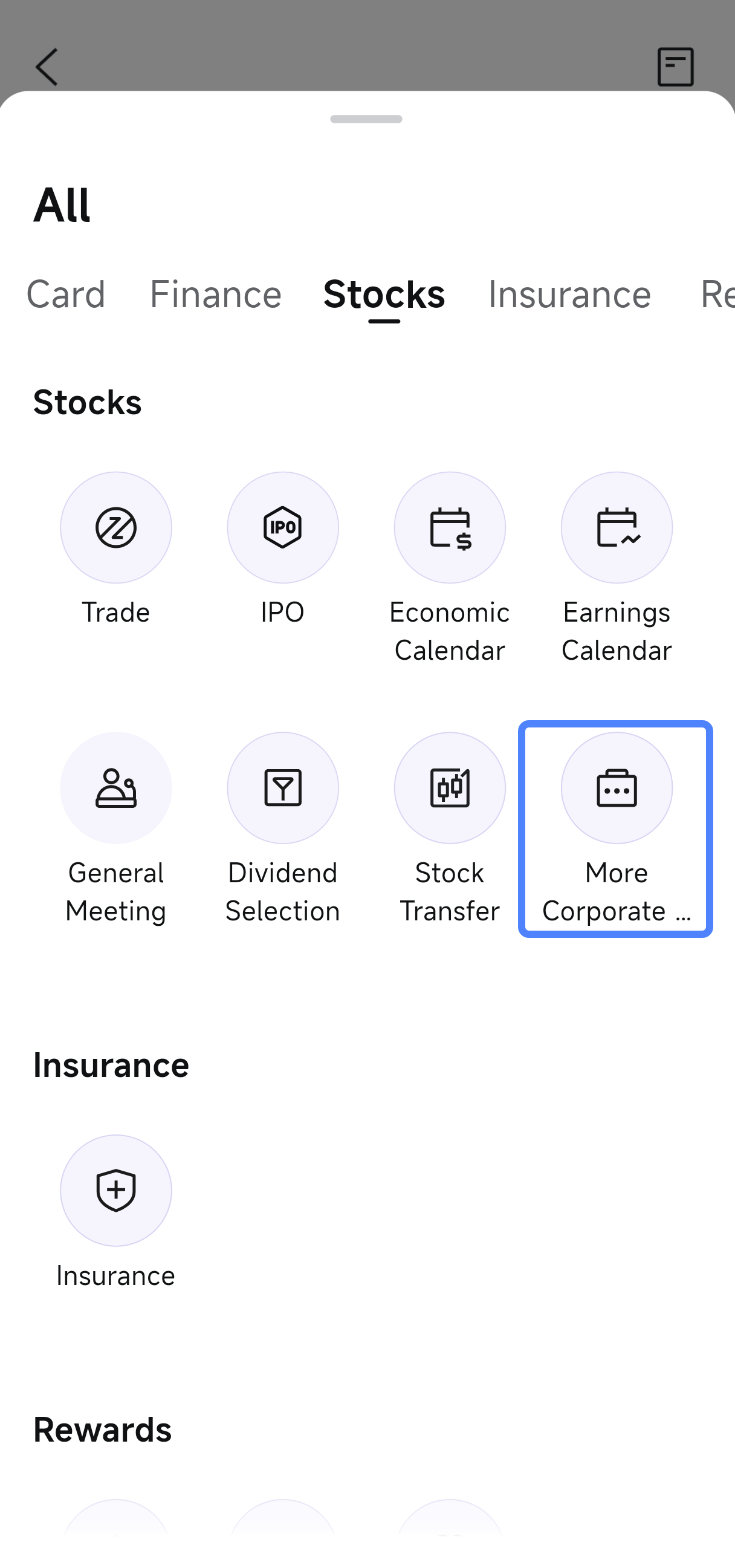
Open the Airstar Bank app and go to:
Account > Select an account > All > More Corporate Actions
Rules:
1) Oversubscription is not permitted. The maximum number of shares you can apply for is limited to your eligible holdings.
2) Subscriptions for odd lots (less than a board lot) are allowed. You do not need to subscribe in whole board lots.
3) Applications cannot be submitted if there are insufficient cash funds in your account.
Fees:
A handling fee will be deducted for subscribing to new shares. For details on the calculation method, please refer to the
fee schedule.
3. Risk disclosure
To protect your interests and avoid losses, please note the following:
3.1 Rights are not ordinary shares. They are highly leveraged and have a short trading period. If you do not exercise your rights before they expire, you may lose all the principal you invested.
3.2 Once you exercise your rights and before the shares are allotted, you are exposed to the risk of a share price decline.
3.3 You are responsible for monitoring the trading and subscription dates for rights. Airstar Bank will only provide reminders as required by its obligations.
3.4 Rights issues offer less flexibility and higher leverage, resulting in greater risk compared to ordinary shares. If you buy ordinary shares in the market, you can immediately sell to take profit or cut losses when the price moves. However, if you acquire shares through rights issues, you must bear share price fluctuations during the subscription and allotment period.
Trading rights may seem to allow you to earn similar profits with less capital, but this reflects high leverage and a short trading window, both of which carry substantial risk. If the underlying shares are illiquid, trading rights become even riskier. Since rights are only tradable for a few days, any incorrect market judgment can result in quick losses.
If the share price rises or falls after ex-rights, the price movements of rights will usually be much greater than those of the underlying shares, reflecting significant leverage. The higher the leverage, the greater the price fluctuation, increasing the risks of short-term trading significantly.